Login
Contact


 Share :
Description
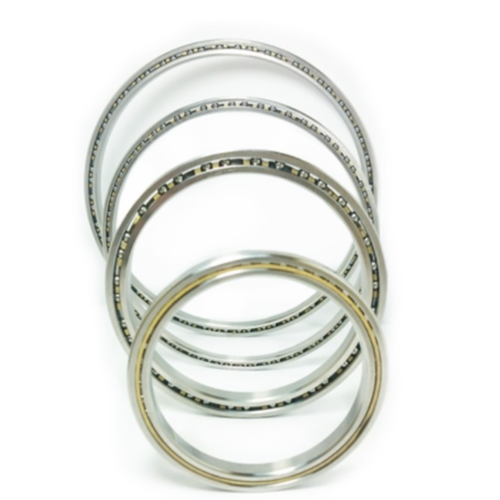
Thin-Section Bearings (also known as Thin-Walled Bearings) are a highly specialized type of rolling bearing. Their defining characteristic is a thin and constant cross-section.
Unlike standard bearings, regardless of how much the inner diameter increases, the cross-section (the difference between the inner and outer diameters, as well as the width) remains unchanged. Because of this unique feature, they are also referred to as "constant cross-section thin-section bearings."
Below is a comprehensive overview of their core features and applications:
1. Core Features
Ultimate Space and Weight Savings: Due to their extremely thin walls and small cross-sections, these bearings significantly reduce the envelope size of mechanical designs and drastically cut down equipment weight. This also frees up valuable internal space for routing lines, such as electrical wiring and air tubes.
Low Friction and Low Torque: With smaller contact areas and rolling elements, they exhibit exceptionally low frictional torque during operation. This effectively minimizes energy consumption and reduces heat generation.
High Rotational Accuracy and Rigidity: Despite their thin profiles, precision manufacturing and advanced engineering allow them to deliver outstanding rotational accuracy and sufficient structural rigidity once preloaded.
Multiple Structural Configurations: Much like standard bearings, thin-section bearings are available in various configurations—including deep groove (C-type), angular contact (A-type), and four-point contact (X-type)—to accommodate diverse loading requirements.
2. Why Are Thin-Section Bearings Needed?
In traditional bearing design, as the inner diameter (bore size) increases, the bearing's thickness and outer diameter must grow proportionally, making the component incredibly bulky. Thin-section bearings break through this limitation, achieving a perfect balance of "large bore, light weight, and compact space."
Main Applications
Thin-section bearings serve as critical components in modern high-precision, lightweight, and automated equipment. They are widely utilized in:
Robotics & Automation: Industrial robot joints (such as adjacent to harmonic drives) and robotic arms.
Semiconductor Manufacturing Equipment: Wafer handling robot arms and precision positioning stages.
Aerospace & Defense: Radar antennas, satellite equipment, and optical targeting systems.
Medical Devices: CT scanners, surgical robots, and X-ray machines.
Precision Optical Instruments: Astronomical telescopes and high-end camera gimbals.
Unlike standard bearings, regardless of how much the inner diameter increases, the cross-section (the difference between the inner and outer diameters, as well as the width) remains unchanged. Because of this unique feature, they are also referred to as "constant cross-section thin-section bearings."
Below is a comprehensive overview of their core features and applications:
1. Core Features
Ultimate Space and Weight Savings: Due to their extremely thin walls and small cross-sections, these bearings significantly reduce the envelope size of mechanical designs and drastically cut down equipment weight. This also frees up valuable internal space for routing lines, such as electrical wiring and air tubes.
Low Friction and Low Torque: With smaller contact areas and rolling elements, they exhibit exceptionally low frictional torque during operation. This effectively minimizes energy consumption and reduces heat generation.
High Rotational Accuracy and Rigidity: Despite their thin profiles, precision manufacturing and advanced engineering allow them to deliver outstanding rotational accuracy and sufficient structural rigidity once preloaded.
Multiple Structural Configurations: Much like standard bearings, thin-section bearings are available in various configurations—including deep groove (C-type), angular contact (A-type), and four-point contact (X-type)—to accommodate diverse loading requirements.
2. Why Are Thin-Section Bearings Needed?
In traditional bearing design, as the inner diameter (bore size) increases, the bearing's thickness and outer diameter must grow proportionally, making the component incredibly bulky. Thin-section bearings break through this limitation, achieving a perfect balance of "large bore, light weight, and compact space."
Main Applications
Thin-section bearings serve as critical components in modern high-precision, lightweight, and automated equipment. They are widely utilized in:
Robotics & Automation: Industrial robot joints (such as adjacent to harmonic drives) and robotic arms.
Semiconductor Manufacturing Equipment: Wafer handling robot arms and precision positioning stages.
Aerospace & Defense: Radar antennas, satellite equipment, and optical targeting systems.
Medical Devices: CT scanners, surgical robots, and X-ray machines.
Precision Optical Instruments: Astronomical telescopes and high-end camera gimbals.
Related Products
Plastic Bearings
Ceramic Bearing
Hybrid Ceramic Bearings
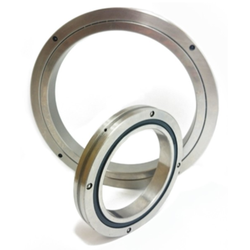
Crossed Roller Bearing
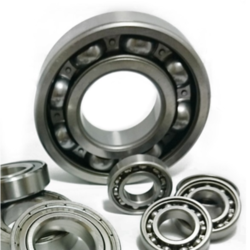
Deep groove ball bearing
You may also like
Highest Rated Products
Back
 Product Inquiry